
A Multi-Ethnic Alignment Normative Study (MEANS)
We have had the privilege of collaborating with multiple international sites to establish a cohort of asymptomatic volunteers (468) with no prior spinal pathology. This was done to develop a more detailed understanding of spinal alignment. We have to understand normal to identify abnormal !
I am proud to share that we now have several publications addressing this topic and I will try to share some key points in upcoming posts.
Key Points:
- Thoracic Kyphosis does NOT correlate with PI
- Lumbar lordosis is better predicted if we use PI AND thoracic kyphosis – PI alone is only partly useful.
- Age accounts for minimal decrease in Lumbar lordosis in asymptomatic people
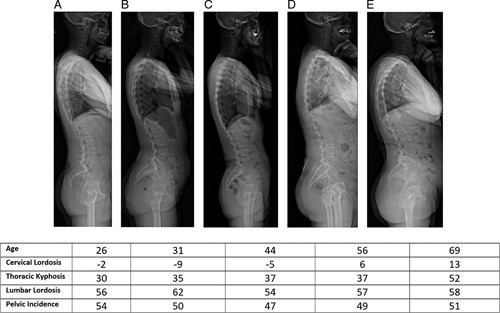
- Thoracic kyphosis increases with age
- Cervical lordosis increases with age to compensate for increasing thoracic kyphosis. Therefore, Cervical SVA (C2-C7 SVA) is maintained with age
- Slight cervical kyphosis in young people is NORMAL
cervical alignment is dependant on throacic alilgnment: CL=−24.5+1.1 (T1slope)
Key results:
Cervical lordosis from C2 to C7: −0.4±12.7°
T1-slope: 23.0±7.9°
Thoracic kyphosis (TK) from T4 to T12: 37.4±10.9°
L1–S1 lumbar lordosis (LL): −57.4±11.3°
Pelvic incidence (PI): 52.0±10.7°
Pelvic tilt (PT): 12.5±7.3°
PI-LL mismatch: −5.4±10.7°
Cervical sagittal vertical axis (cSVA): 19.0±9.8 mm
Age based equations for predicting LL which I use routinely now:
Age 18-28: LL=8.6+0.55(PI)+0.61(TK); r2=0.77
Age 29-37: LL=5.8+0.62(PI)+0.57(TK); r2=0.75
Age 38-50: LL=5.9+0.57(PI)+0.58(TK); r2=0.78
Age 51-64: LL=8.6+0.56(PI)+0.46(TK); r2=0.69
Age > 64: LL=4.0+0.51(PI)+0.53(TK); r2=0.66
Regarding PI-LL mismatch:
60% of volunteers met the PI-LL criteria within ±10°
PI-LL mismatch of ≥10° in only 8.3%
LL was higher than PI by ≥10° in 32.1%
#neurosurgery #physicaltherapy #spine #spinehealth #spinesurgery #spinesurgery #scoliosis #scoliosissurgeon #spinedeformity #spinaldeformity #idiopathicscoliosis #degenerativescoliosis #kyphosis #flatback #spinalalignment
Age and Gender Based Spinopelvic and Regional Spinal Alignment in Asymptomatic Adult Volunteers
 Sardar Spine - Top Spinal Disorders Surgeon