
A Multi-Ethnic Alignment Normative Study (MEANS)
Here is what we learnt for Lumbar segmental alignment and distribution from the MEANS population.
Key Points:
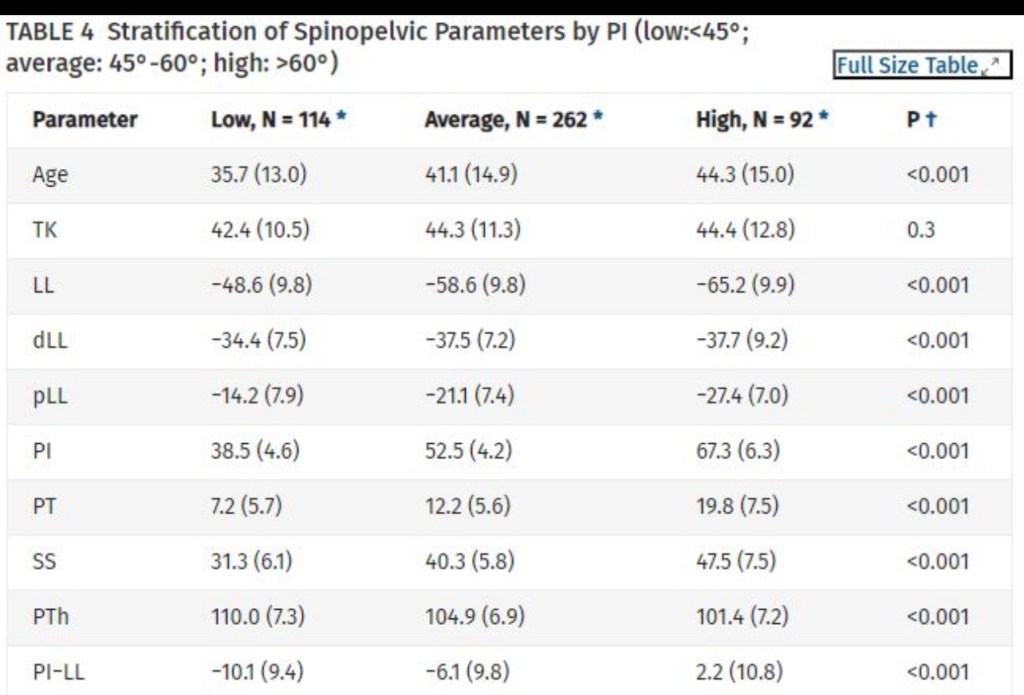
- L4-S1 lordosis has a very weak correlation with PI and essentially is independant of PI. So, high PI does NOT mean high L4-S1 lordosis ! Average L4-S1 lordosis is around 35°-38° across the range of high to low PI
- L1-L4 lordosis correlates with PI and increases with PI to add that extra lordosis for people with high PI
- High PI leads to increase in L1-L4 lordosis and more cranial migration of the Apex of the Lumbar lordosis
- Lumbar Lordosis Apex was most commonly at L4 (56.6%, Mean PI: 49) followed by L3 (40.2%, Mean PI: 56)
- Age did not correlate with Lumbar Lordosis
- PI-LL mismatch varies with PI as well. Low PI patients have LL HIGHER than PI. High PI patients have LL closer to or slightly LOWER than PI
Equation for predicting L1-L4 lordosis which I use:
L1-L4 = -0.4(PI) + 2.2
Equations for predicting L1-S1 lordosis were given in the earlier post. L4-S1 lordosis can be calculated as a difference between total lordosis and L1-L4 lordosis
Key Results:
Mean PI: 52.0°
Mean LL: −57.4°
Mean L1-L4: −20.6°
Mean L4-S1: −36.8°
Percentage of LL attributed to L4-S1 was 65.0% (95% CI: 63.9%, 66.2%)
#neurosurgery #physicaltherapy #chiropractor #spine #spinehealth #spinesurgery #spinesurgery #scoliosis #scoliosissurgeon #spinedeformity #spinaldeformity #idiopathicscoliosis #degenerativescoliosis #kyphosis #flatback #spinalalignment
Variation in Lumbar Shape and Lordosis in a Large Asymptomatic Population
https://www.ingentaconnect.com/content/wk/brs/2023/00000048/00000011/art00006
 Sardar Spine - Top Spinal Disorders Surgeon